1. Overview
A kernel module provides a way to extend kernel functionality without rebuilding the entire kernel. Using the Buildroot toolchain ensures the module is ABI‑compatible with the kernel generated during your Buildroot build. QEMU then offers a convenient emulation environment to test modules without hardware.
2. Prepare the Workspace
Create a folder to store the module sources.
mkdir -p ~/project/kernel-study/0.hello-world/hello
cd ~/project/kernel-study/0.hello-world
3. Write the Kernel Module
Create hello.c:
#include <linux/init.h>
#include <linux/module.h>
#include <linux/kernel.h>

MODULE_LICENSE("GPL");
MODULE_AUTHOR("Rishav");
MODULE_DESCRIPTION("Simple Hello World Module");

static int hello_init(void)
{
    pr_info("Hello World from Buildroot module!");
    return 0;
}

static void hello_exit(void)
{
    pr_info("Goodbye from Buildroot module!");
}

module_init(hello_init);
module_exit(hello_exit);
4. Create the Makefile
Update the paths to match your Buildroot output directory.
obj-m := hello.o

BUILDROOT_SRC_DIR=~/project/Platform/buildroot
KDIR := $(BUILDROOT_SRC_DIR)/output/build/linux-*/
CROSS_COMPILE := $(BUILDROOT_SRC_DIR)/output/host/bin/aarch64-linux-

all:
	$(MAKE) ARCH=arm64 CROSS_COMPILE=$(CROSS_COMPILE) -C $(KDIR) M=$(PWD) modules

clean:
	$(MAKE) ARCH=arm64 CROSS_COMPILE=$(CROSS_COMPILE) -C $(KDIR) M=$(PWD) clean
KDIRmust point to the kernel build directory created by Buildroot.
5. Build the Module
Run:
make
The output should include:
hello.ko
This is the loadable kernel module.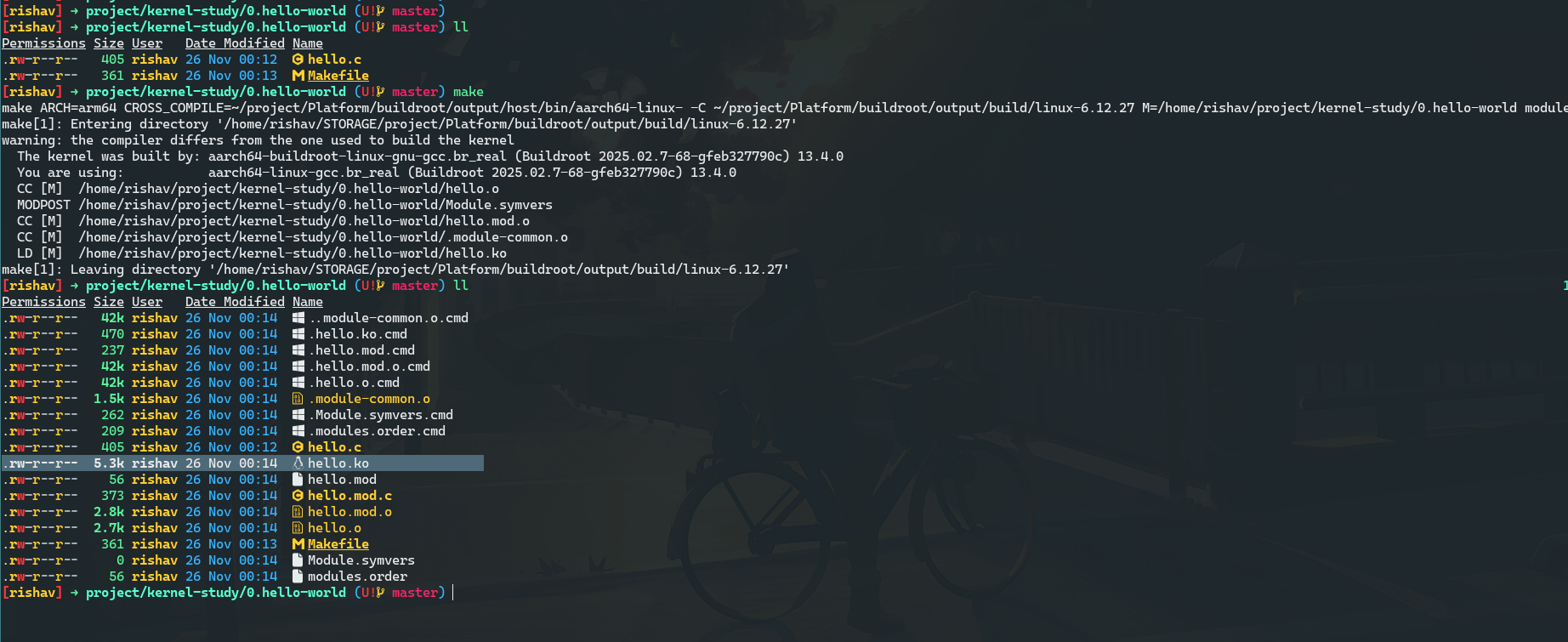
6. Start QEMU With a Shared Folder
Use the Buildroot-generated QEMU launch script with an added port forwarding option:
-netdev user,id=eth0,hostfwd=tcp::2222-:22
-device virtio-net-device,netdev=eth0
Using this, the port 22 from target/guest machine which is used for ssh can be accessed at port 2222 in host machine.
Now, transfer .ko file inside target machine
scp -P 2222 hello.ko root@localhost:/root/
7. Insert the Kernel Module
Load the module:
insmod /mnt/host/hello.ko
Check the logs to see expected output:
$ dmesg | tail
Hello World from Buildroot module!
8. Remove the Module
Unload it:
rmmod hello
dmesg | tail
Expected output:
Goodbye from Buildroot module!
9. Summary
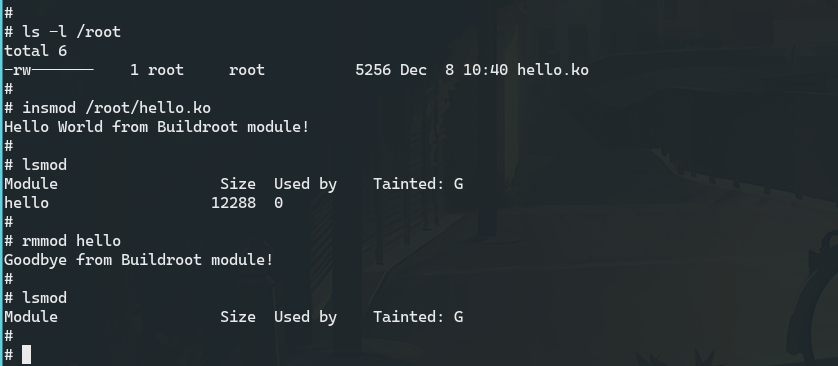
You now have a complete workflow for:
- Writing a kernel module
- Compiling it using a Buildroot cross‑toolchain
- Running and testing inside a QEMU environment
This setup is ideal for iterative development of kernel drivers, subsystems, and platform code without needing hardware.